



Eyelet Curtains & Grommet Top Window Drapes: A Complete Guide
 Image by Will Ellis Photography
Slide a curtain onto a pole and watch it fall into deep, even waves: that is the simple appeal of the eyelet heading. Eyelet curtains, also called grommet top curtains, have rings set into the heading, so the pole threads straight through the fabric, with no hooks or separate curtain rings to fit. The folds run evenly from top to hem, the curtains glide easily even when they are wide or heavy, and the clean heading suits modern and casual rooms best. They need a pole rather than a track, about 2x fullness (a total width about twice the length of the pole), and an extra 4 cm on the drop for the upstand of fabric that sits above the pole.
Known for their smooth operation, simple construction and uniform gather, eyelet curtains are an incredible mix of form and function. If you’re looking for custom curtains with a heading style that brings a contemporary feel and offers excellent functionality - cheers! You’ve found the right one.
But apart from the uber-chic appeal and the operational ease, there are many more reasons to love eyelet curtains. Discover these reasons as you read. Also, lay your hands on tips to style eyelet window curtains fittingly for your space.
What are Eyelet Curtains?
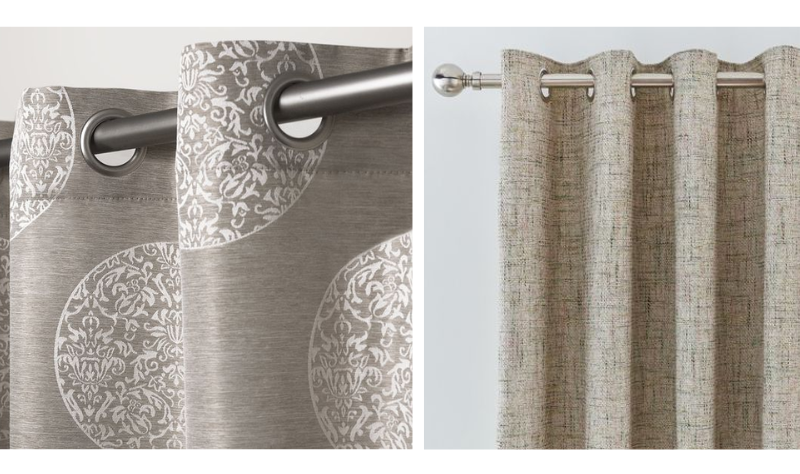 Image by Exclusive Home
Curtain styles get their name from the header’s construction; grommet tops get theirs from the eyelet rings that punctuate their header. Instead of hanging on rings or fabric loops/pockets, these curtains hang directly from the drapery poles that pass through these eyelets or grommets.
Thanks to these eyelets, the curtains glide easily on the pole, facilitating the non-fussy operation that most clients seek. This is especially beneficial on oversized windows or sliders with extra wide panels or heavy draperies where the embossed rings provide immense ease of operation as you draw the drapery open and close.
But the role of the eyelets is not confined to the functional; they are decorative too. Capable of sporting a wide range of hues and finishes, the eyelets, made of metal or plastic, add an element of visual interest to the curtain panel, and are usually coordinated with the colour of the drapery pole and finials. While the plastic eyelets are economical and come in a wider variety of colours, the metal ones are more sturdy and render a modern industrial edge to the drapery.
What are the Reasons to Choose Eyelet Curtains?
 Image by Blue Ladder Studio / Jessica Glynn
Curtains are both decor pieces and functional accessories. Eyelet top headers ensure that the curtains offer top-notch performance on both accounts. But besides their simple elegance and impressive functionality, there are many reasons for eyelet tops being in high demand, such as:
MODERN STREAMLINED LOOKS: Eyelet tops have sleek headers as compared to traditional ornate styles of drapery. Barring the presence of eyelets, the header is rather minimal and the pleats fall straight from top to bottom in an architectural manner. That makes grommet tops a fitting candidate for modern homes and streamlined decor styles. Owing to their unmessy headers, they are one of the most preferred styles of drapery for bold patterns, modern geometric and abstract print fabrics as the uniform and equally spaced pleats show them in the best light.
DEEP PLEATS: Unlike styles like rod pockets and flat panel curtains that form pleats by projecting on the front side of the drapery pole, eyelet curtains’ pleats project backwards too, hence they have deep pleats. Even without any elaborate construction, eyelet tops convert a window into a dramatic focal point with their sculptural pleating and wavy contours. Whether designed in solids or patterns, the vivid play of light and shadow on their rippled body is a striking feature that few heading styles might proffer to such an architectural degree.
SLEEK STACKS: Precisely because the fabric extends behind the drapery pole almost as much as on the front, the folds are deep, but ever so slim. Hence, these curtains need relatively less stacking room when they are drawn aside from the window. If you’re dealing with windows that have little to no space around their frame to stack the curtains when they are not in use, eyelet tops are a very good choice.
EASE OF MOVEMENT: The eyelets glide easily on the pole, providing ease of movement, no matter how heavy or wide the drapery. That makes them great options for frequently used and over-sized windows.
SAVE ON ACCESSORIES: Given that the rings are embedded into the header, you don’t have to spend money and energy on shopping and fitting accessories for the drapery to hang them. The curtains come ready to mount; all you need is the drapery pole.
SHOW OFF HARDWARE: Since the curtains leave the hardware partially uncovered, you have the scope to show off the beautiful poles and their finials while using them to create colour contrast too.
WIDTH FLEXIBILITY: The pleats of this drapery are formed by gathering the panel on the pole. Hence, they can be stretched or shrunk to provide more or less coverage. When stretched, they will display shallow pleats and when shrunk, the pleats will gather close and look lush. This flexibility makes it easier to measure and specify width for eyelet top panels. While we advise precision when specifying sizes of pinch pleat drapery widths, eyelet tops are very forgiving of minor width measurement errors.
What are the Factors to Consider When Shopping for Eyelet Curtains?
 Image by Tineke Triggs
Crisp design and modern clean lines, no-fuss operation and minimum accessories - these are the gratifying elements of eyelet tops. That sounds like the perfect drapery for any home. But, before you rush to shop for them, also factor in the following:
SUITABILITY OF HARDWARE: If you have curtain tracks (not poles) installed in the home, note that eyelet tops are incompatible. So, you’ll have to replace the tracks with drapery poles to be able to mount eyelet curtains. Also, be wary of using metal eyelets if your poles are wooden as they may cause abrasion and strip them of their polished looks.
EXPOSED HARDWARE: Eyelet curtains leave the hardware exposed even when the curtains cover the window. If you don’t like to expose drapery poles or don’t want to invest in expensive show-worthy hardware, this style may not be for you.
COMPATIBILITY WITH DECOR STYLE: Eyelet tops have a contemporary feel to them because of their minimalist construction. For a traditional home or extravagantly embellished decor styles, eyelet tops may not be the best match.
CASUAL AESTHETIC: The non-dressy visual appeal of eyelet tops makes them a perfect fit for casual decor styles and family rooms. But, if you are dressing up windows in ultra-formal spaces, dressier pinch pleat styles like goblet tops or triple pinch pleats would look more apt.
LIGHT LEAKS AND HARDWARE PLACEMENT: Eyelet tops allow some light to leak into space through their eyelets. But if your heart is set on this style for all the benefits outlined above, we recommend mounting the drapery pole as high above the window trim as possible so light leaks can be minimised. A sewn-in blackout lining, in white, beige or grey, darkens the room much more.
WINDOW WISDOM: TIPS TO BLOCK LIGHT LEAKS
MEASUREMENT SPECIFICATIONS: Eyelet tops look best when sewn with 2x fullness. For the best visual presentation, make sure that you order accordingly. So, if your pole is 90 cm long, go for two panels of 90 cm each for 2x fullness. Don’t make the mistake of ordering one 90 cm wide panel or a pair of 45 cm wide panels as these will barely cover the windows and not have enough extra width to form pleats.
SINGLE PANEL COVERAGE: If you have a long drapery pole with a centre support bracket, you will have to consider how many panels to order since eyelets cannot move past the brackets. A one-way draw, single curtain panel is not an option with a hardware setup including centre-support brackets.
MODERN, BUT NOT BESPOKE: Machine-enabled mass production of eyelet top curtains has made them ubiquitous, inexpensive and that much less bespoke in their visual appeal. Since the biggest takeaway from made-to-measure drapery is its personalised appeal, this is often discouraging for those who want their homes to feel luxurious, one-of-a-kind and curated over time. If it is this ‘bespoke appeal’ that you’re chasing as well, there may be other styles of drapery that can better meet your vision.
What are the Hardware Options for Eyelet Curtains?
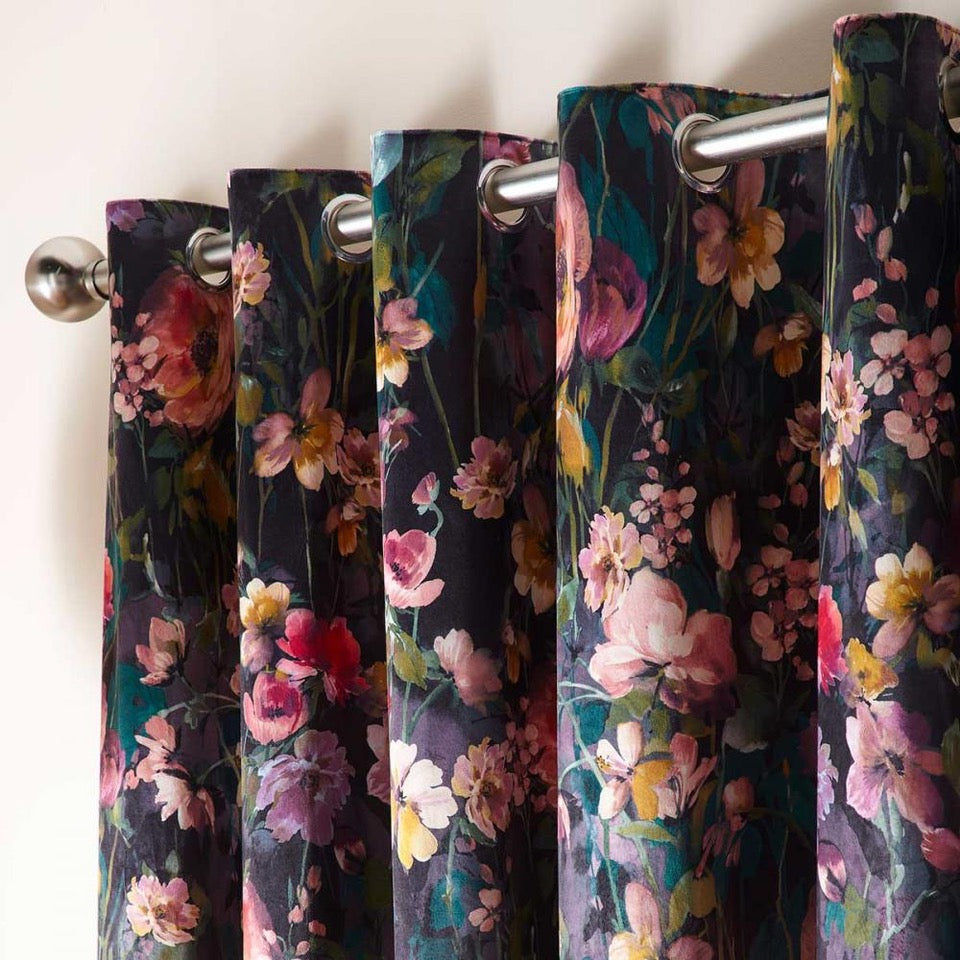 Image by Studio G
Eyelet curtains can be mounted on any style of drapery poles, which is great news if you have poles installed already because there is nothing more you need to invest in - no rings or pins or hooks. Since the curtains come with the eyelets embossed into the header, all you need to do is slide your eyelet panel onto the pole.
At time of purchase, we do recommend checking whether the grommet sizes are right for the diameter of your pole. Extra chunky or extra skinny poles may need non-standard grommet sizes. To help you get the perfect size of grommets for your poles, our collection offers grommets in these sizes and finishes/colours:
- Standard-size grommets (4 cm inner diameter): Available in silver, bronze, gold and black
- Large-size grommets (5 cm inner diameter): Available in silver and bronze
- Small-size grommets (2.5 cm inner diameter): Available in silver only
Note that eyelet tops are not compatible with curtain tracks. If you already have installed tracks in your home and would prefer to not have to swap for new hardware, we recommend considering drapery designed in other heading styles like our flat panel top curtains or pinch pleat drapes.
How to Hang Eyelet Curtains
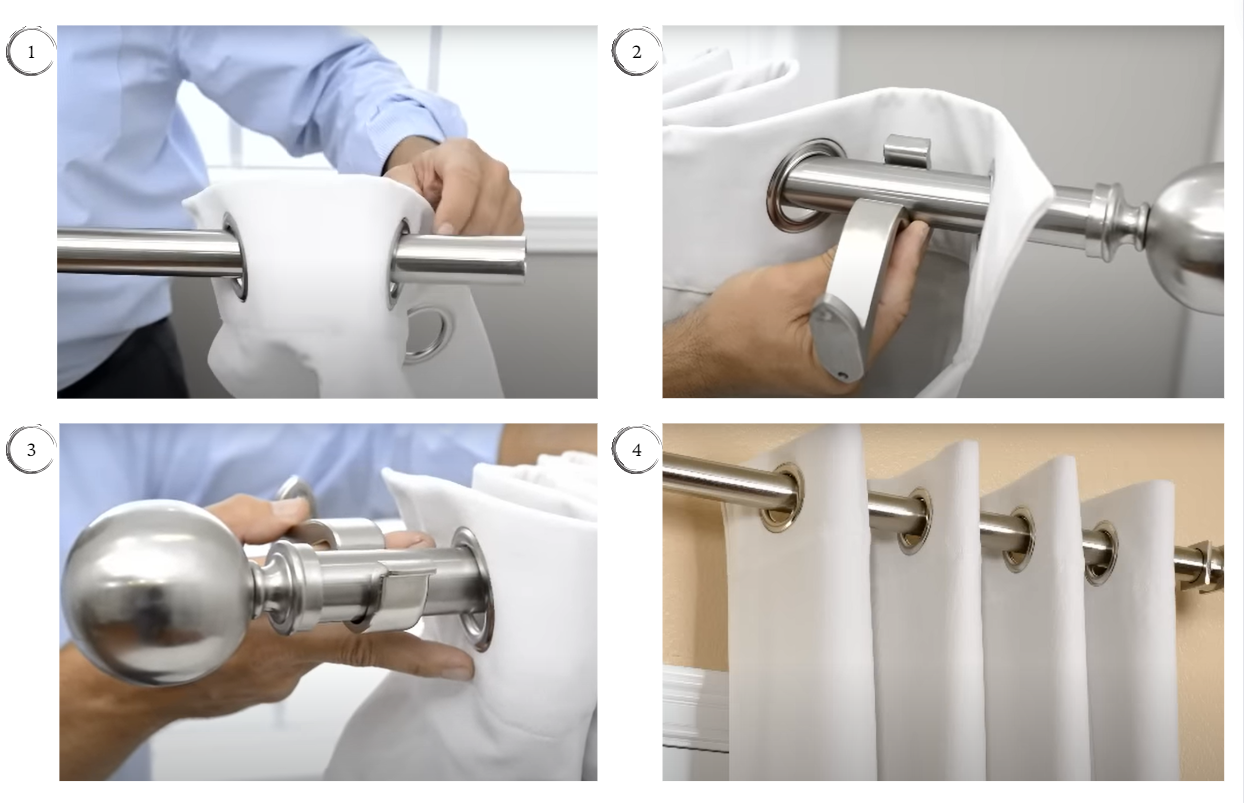
Since eyelet curtains come with stitched-in eyelets, hanging them is a breeze! Here’s how you go about it:
STEP 1: Glide in the Eyelets - Thread each of the eyelets of your eyelet curtains onto the drapery pole with care, ensuring that you do not miss any eyelet. If the curtains are heavy, having an extra hand can be helpful.
Keep in mind that the returns (edges) of the curtains should be turned inwards towards the wall or window, and not outwards towards you as you position the first eyelet. Otherwise, it can result in the fold/pleat direction being reversed, with the back of panels showing on the edges, and light leaking in through the return/edges.
Additionally, take care to position the first eyelets before the first bracket on both sides to lock in their position. This way the curtains won’t keep gliding to the centre.
STEP 2: Mount the Pole - Once all the eyelets are slid onto the pole, position the pole onto the brackets. Tighten any screws to hold the pole steady in its place. Double-check its level and centre before securing it.
STEP 3: Attach the Finials - After ensuring the curtain pole is securely in place, it's time to screw in the finials, adding that extra touch of finesse and completing the overall look of your window treatment.
How to Measure Eyelet Curtains
 Image by Laure Joliet
Eyelet curtains are admired most for the sculptural feature of their deep folds which run in a uniform wavy pattern from the top to the bottom. But this can only be achieved when you get the measurements right, which is easy as a breeze if you follow the given steps:
HOW TO MEASURE LENGTH
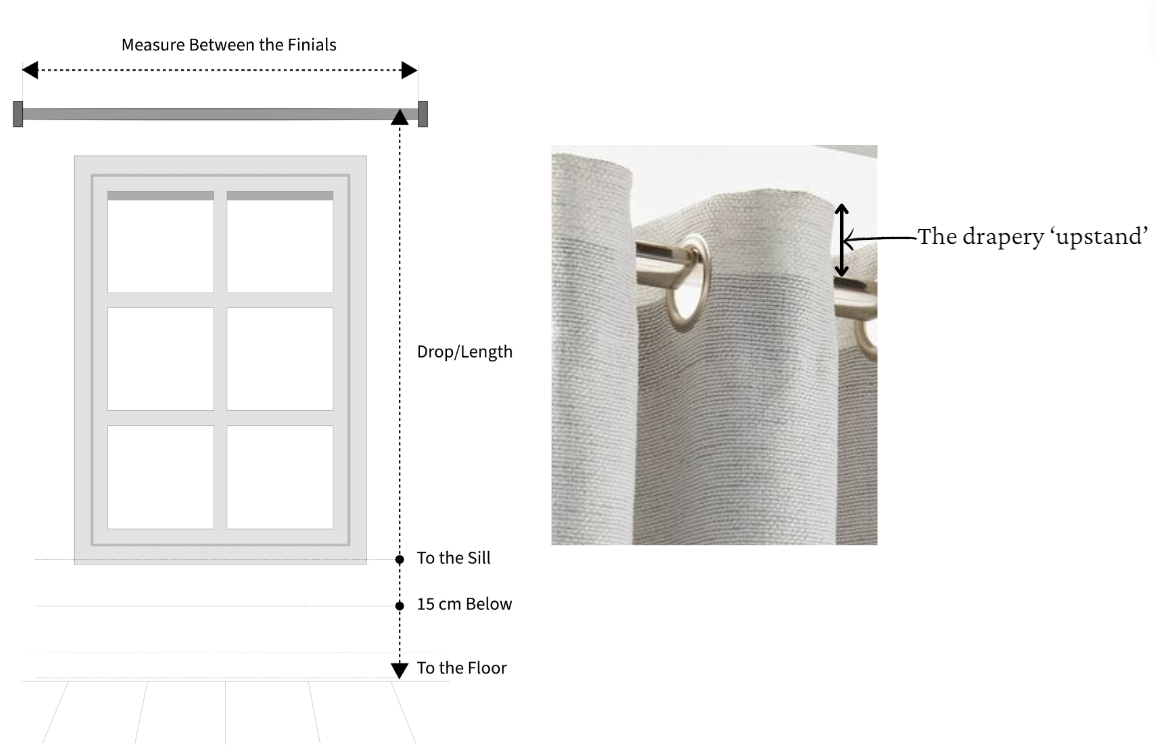
Start by measuring the length from the top of the drapery pole to the desired endpoint. To that figure, add 4 cm to account for the ‘upstand’ (the portion of the curtain header that stands above the pole) of the eyelet curtains. And you’ll have the final length to specify in your order for eyelet curtains from us. That simple!
As to what the endpoint should be, you may choose between any of the standard sizes of short curtains that stop at the sill or long curtains that reach the floor. The choice is entirely personal based on your preferences and requirements.
HOW TO MEASURE WIDTH
To achieve a full, sumptuous look for your eyelet curtains, the panel width needs to be stitched with an optimal ‘fullness factor’ of about 2x. What does this mean? Let us take you through steps to measure panel width and explain.
Start by measuring the width of your pole, finial to finial. Then, for 2x fullness, double this number. This should ideally be the width of your eyelet curtains altogether.
For example, if your pole is 100 cm long, then doubling that figure to 200 cm, we recommend ordering a pair of curtains with a panel width of (roughly) 100 cm each, or a single panel close to 200 cm.
This extra width is to ensure that the panels have enough fabric to form deep round pleats, and not look sparse or flat like a sheet.
For sheer and semi-sheer fabrics, 2x fullness works well too, and our sheers have a chain weight sewn along the hem so they hang straight.
If you are working on a tight budget, you may go as low as 1.5x fullness resulting in less dense pleats, without compromising your drapery’s elegance heavily, but we do not recommend going lower than 1.5x fullness or the drapery may look too sparse and stingy.
Eyelet Curtains: FAQs
Eyelet or pencil pleat curtains: which should I choose?
Eyelet curtains look modern and casual, glide easily and need a pole. Pencil pleat curtains look more traditional, hang from a pole or a track and sit closer to the hardware, so less light creeps over the top. Both need about 2x fullness.
Are eyelet and grommet curtains the same?
Yes. Eyelet is the usual name in the UK and grommet the usual name in the US; both describe curtains with rings set into the heading.
How do you hang eyelet curtains?
Thread the eyelets onto the pole so the first and last ones turn back towards the wall, with the outermost eyelet sitting outside the bracket on each side. Then lift the pole onto its brackets, tighten the screws and fit the finials.
How wide should eyelet curtains be?
About twice the length of the pole in total, and no less than 1.5x. For a 100 cm pole, order a pair of curtains about 100 cm wide each, or a single curtain about 200 cm wide.
How do you measure the length of eyelet curtains?
Measure from the top of the pole to where you want the curtains to end, then add 4 cm for the upstand, the strip of heading that stands above the pole.
Can eyelet curtains go on a track?
No, they need a pole to thread through the eyelets. If you have a track, choose a heading that hooks on, such as flat panel, pencil pleat or pinch pleat.
Do eyelet curtains let in light above the pole?
A little light can creep over the top. Hang the pole well above the frame and wider than the window, and choose our sewn-in blackout lining, in white, beige or grey, if you want a darker room.
In Closing
 Image by Sarah Cole Interiors
Grommet curtains are trend-right draperies that are capable of bringing elegance, softness and operational efficiency to any window. With their deep pleats achieved through simple headers, eyelet curtains can fulfil a wide range of design aspirations. Be it lightweight sheers or heavy velvets, soft solid neutrals or bold intricate patterns, eyelet tops offer the right bit of architectural waviness and detail that can show both in the best light. If you’re convinced that this is the style meant for your decor project, browse through our fabrics and get to the most exciting part - the shopping. The White Window is committed to making this your best online drapery shopping experience ever and to walking the journey to the best made-to-measure drapes with you. Every curtain is made to measure in any of our 2,500+ fabrics and handcrafted by artisans in India. If you need help, email us at info@thewhitewindowcurtains.co.uk. So, buckle up, we’re ready to go!
WINDOW WISDOM: FLAT PANEL CURTAINS | PENCIL PLEAT CURTAINS | CURTAINS FOR LARGE WINDOWS